Chiterion devoted to Customizing Eco Bag Solutions for Shopping, Packaging, Delivery, Storage and Travel Since 2007
Language
Product pages for the vast majority of backpack coolers repeat the same four claims: thermal insulation, leak-proof design, water resistance, and ice retention for "X" hours. Yet, hardly any sellers explain how these performance metrics are actually tested. This guide will help you see past the marketing hype—identifying which specifications truly predict performance, which claims warrant skepticism, and how to select the right product for your actual needs.
Soft-sided backpack coolers prioritize portability. As one buying guide bluntly states, a soft-sided insulated bag cannot replace a refrigerator or heavy-duty long-haul cooler; its design centers on portability rather than peak performance. Most users simply need reliable cooling for 4–8 hours, not sustained low temperatures for a full day. The trade-off between soft bags and hard-shell coolers is clear: hard-shell models can keep contents cold for days but weigh 8–9 kg when empty, whereas most soft-sided backpacks weigh only 0.9–1.8 kg. Understanding this trade-off helps avoid the most common source of disappointment: judging a soft-sided backpack by the performance standards of a hard-shell cooler. A crucial insight before buying is that advertised ice-retention times tend to be overly optimistic. An independent outdoor gear review agency has pointed out that most claimed retention times are inflated, likely derived from ideal testing conditions—such as keeping the unit in a cool indoor space without ever opening the lid. In real-world use, actual cooling performance is often only about half the advertised figure. Other guides note that the gap between laboratory data and real-world performance can be as much as two- or threefold. Notably, one leading brand avoids listing specific retention times altogether, citing the multitude of influencing factors and the vast difference between test conditions and actual usage scenarios. Halving the duration stated on the product page provides a more realistic expectation.
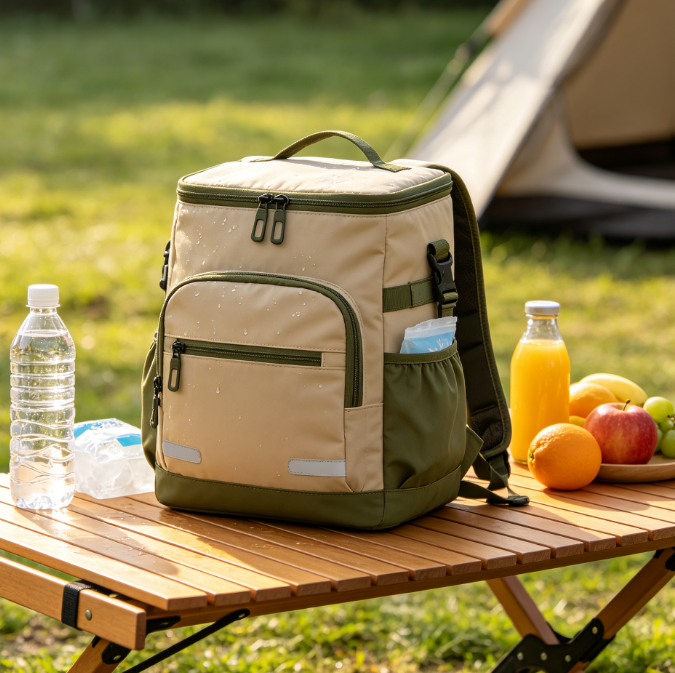
Core parameters that truly determine performance:
1. Insulation layer: thickness and foam cell structure. This is the most critical parameter, yet it is frequently omitted by manufacturers. Buying guides emphasize checking the thickness and material of the insulation layer: 15 mm (or thicker) closed-cell PE foam is the baseline standard. Be wary of products that merely advertise "multi-layer insulation" without specifying the thermal resistance (R-value) or providing independent cooling test data. An aluminum foil reflective layer offers a cost-effective way to significantly boost thermal insulation without adding bulk. Custom advice: Look for clearly stated foam thickness (in millimeters) and confirm it uses a closed-cell structure. The absence of these details is a red flag—some guides list "unspecified insulation thickness" as the number one warning sign for buyers.
2. Seams: Welding vs. Stitching. This is the key factor distinguishing genuine leak-proof performance from mere marketing claims, and it is easily verified. As reviews note, welded (or high-frequency welded) seams are far superior to stitched ones, as needle holes can serve as pathways for leaks. Before trusting "leak-proof" claims, check the specifications for "welded seams" or a "seamless, one-piece liner."
3. Closure: Determining Performance Limits. The sealing capability—and thus the performance ceiling—of an insulated bag depends on its opening. Standard zippers leak if the bag tilts and allow hot air to enter every time the bag is opened or closed; only waterproof/airtight zippers or roll-top designs ensure a true seal. Heat enters through the bag walls, the opening itself, and gaps around zippers or lids; therefore, a high-quality insulated bag must combine thick foam insulation with a highly sealed opening. Additionally, guidelines suggest avoiding bags with capacities over 7L that use only a single-pull standard zipper.
4. Liner: Food-Grade and Easy to Clean. Since the liner comes into direct contact with food, prioritize models clearly labeled as food-grade with smooth, seamless, welded surfaces; stitched fabric liners have seams that trap dirt and are difficult to clean. For this reason, many guides flag PVC materials or uncertified liners as potential risks. Fondofold’s entire range of insulated bags features food-grade liners.
5. Carrying System: Handling Full Loads. A fully loaded insulated bag is heavy, and cheap carrying systems often fail at the shoulder strap attachment points. Guidelines set a clear standard: the strap system must support a load of at least 6.8 kg (15 lbs), alongside welded seams and waterproof zippers. For long-distance carrying, prioritize models with a chest strap; for large-capacity bags, a waist belt is recommended.
6. Capacity: Check the Actual Figures. There are two common pitfalls here: First, exaggerated capacity claims—an analysis of user complaints reveals that misleading capacity labeling is a frequent issue, with discrepancies between nominal and actual capacity reaching up to 22%. Second—and more importantly—the nominal volume of an insulated bag often includes the space occupied by ice. The industry-standard ratio of ice to contents is approximately 2:1; therefore, a 24L cooler bag cannot actually hold 24L of food. A practical benchmark for efficiency is that the weight of a soft-sided cooler bag should ideally not exceed 0.3 pounds per quart of capacity.

Chiterion is committed to designing, manufacturing and supplying a wide range of ecological packaging products and solutions.